
Fighting misinformation and disinformation needs to be a national priority in Canada
Alberta is barrelling towards a separation referendum and there's no sign our leaders are taking the threat seriously

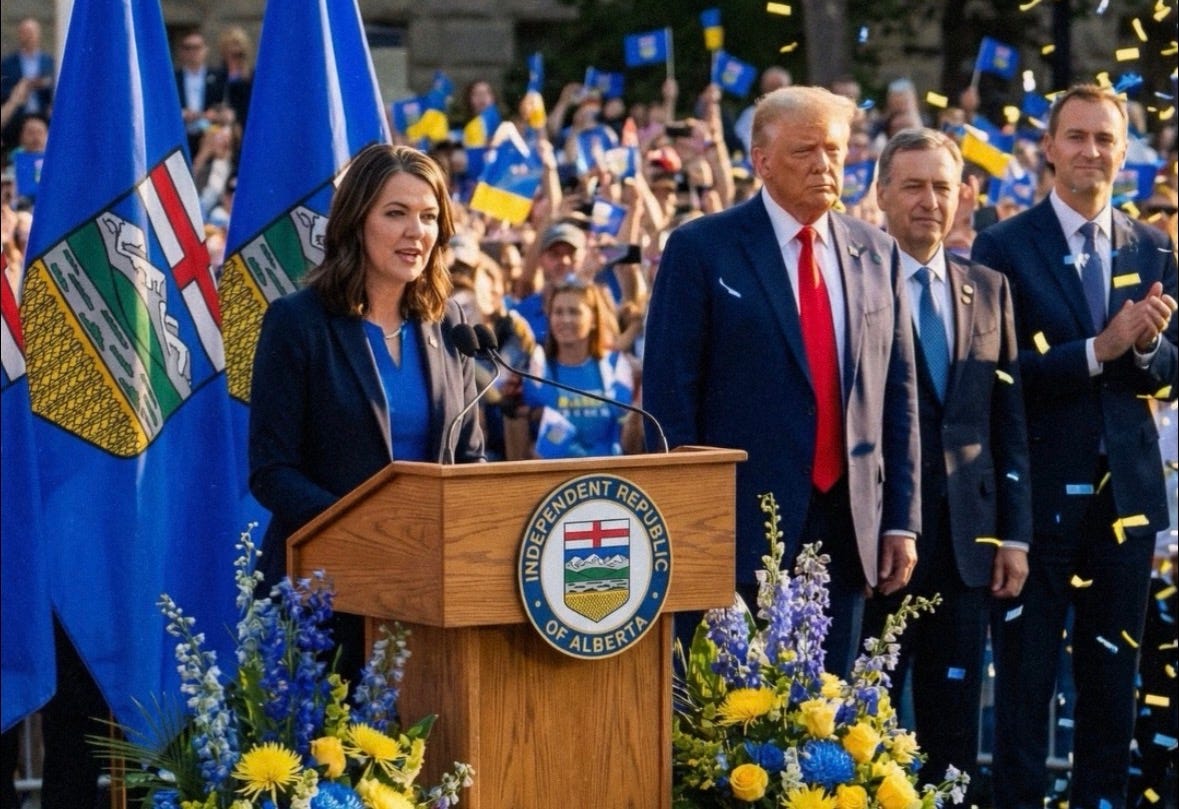
Albertans will soon be faced with a series of referendum questions ranging from limiting the access immigrants have to health care and education, abolishing the Canadian Senate, allowing the provincial government to appoint federal court judges, and the big one — separation from Canada.
These questions, which are expected to be put to Alberta voters on October 19, 2026, are already accompanied by a storm of misinformation and disinformation that is dominating many peoples main sources of information — their social media feeds.
Misinformation is false or inaccurate information that is shared without harmful intent. Disinformation is deliberately shared false information that is intended to deceive.
With the referendum questions in mind, I shared concerns in a recent episode of the Daveberta Podcast that it feels like there is a real lack of urgency from our elected leaders about the level of misinformation and disinformation being spread and targeting Albertans from at home and abroad on social media.
Commentators, like University of Calgary professor Jean-Christophe Boucher, have raised the alarm, recently describing Alberta as “excessively vulnerable to American interference.”
“Alberta is not ready at all. It’s almost completely unready,” Patrick Lennox, a former director of intelligence with the RCMP, told the CBC. “There is no capacity whatsoever to push back against that form of misinformation and disinformation that’s going to happen.”
These referendum questions could redefine our politics and divide communities and families in Alberta like never before — and will almost certainly be the target of foreign powers and domestic players who have an interest in destabilizing our country.
University of Alberta researcher Timothy Caulfield has spoken frequently about the threat of misinformation, including to CTV’s Alberta Primetime host Michael Higgins back in March 2025:
I think it is important to note out of the gate, this happens across the ideological spectrum, especially at the extremes, but a growing body of evidence tells us in this cultural moment, we’re seeing more misinformation come from populist parties. I’ll let you do your own sort of definition of what that might mean, populist parties.
It’s become almost the norm, not just in Canada but really around the world, for these kinds of political entities to use misinformation to forward their agendas. Just look what happened in the United States. We know that misinformation about particular topics, whether it’s immigration, or crime, or the economy, or climate change, really did have an influence on voter decisions. We’re likely to see the same thing happening here in Canada.
Of course, the misinformation crisis goes beyond electoral politics and social issues. Speaking on TVO’s Big [If True] podcast, Caulfield explained that a huge percentage of the health information online today is misleading. He described the spread of health misinformation as one of the greatest threats of our time.
A flood of AI-generated disinformation
Misinformation and disinformation isn’t new, but the speed it can travel and audience it can reach has exploded through social media platforms.
There is a flood of misinformation and disinformation about Alberta’s separation from Canada, commonly found in the form of social media influencers and Artificial Intelligence-generated videos, images and charts, pouring into social media feeds. It’s unclear who runs many of these anonymous social media accounts that publish this AI-generated content or where in the world they are posting from.
It has never been easier for malicious actors at home and aboard to interfere and attempt to destabilize our politics and society — and the deeply divisive issue of separation and the increasingly troubling divided opinions about immigration — are easy targets.
Alberta separatists have existed on the fringes of the political far-right for decades, and it’s an issue that a recent Leger poll showed is supported by only 17 per cent of Albertans. But the efforts to amplify it into a mainstream issue today are hard to ignore. The referendum could result in the normalization of Alberta separatism and far-right politics in our provincial and national politics.
At a session I attended at the Broadbent Institute’s Progress Summit in Ottawa earlier this month, Andrew Eldredge-Martin shared research showing that one of the top YouTube content creators posting about Canada’s economic and political future was a newly created account called Rebuilt AutoSpace (I don’t want to link to it here, but you can easily find it using a search engine).
This anonymous account has been churning out thousands of AI-generated racist videos on YouTube Shorts attacking Somali and Punjabi immigrants in Canada and accusing them of being criminals. The videos are filled with racist stereotypes and have had millions of views. It’s unclear who is behind this account and creating these AI-generated videos.
The research shared in Eldredge-Martin’s session also showed that video content on YouTube promoting negative narratives on the economy got twice as many views than positive narratives, on average. It’s clear that the people behind the account have figured out the formula to making the YouTube algorithm work for them.
These videos mirror some prominent themes included in Alberta separatist content, which frequently call for mass deportations of immigrants and promote the “Make Alberta Great Again” slogan inspired by United States President Donald Trump’s Make America Great Again movement.
Other AI-generated images, like the one above that was posted on a popular separatist Instagram account, show Premier Danielle Smith and Trump celebrating the creation of an Alberta Republic — tipping the hand of the many Alberta separatists who see the referendum as a step to becoming the 51st State.
We should expect that Alberta separatist groups and their social media channels are also being treated as an eagerly open conduit for those in and close to the Trump administration who want to influence and destabilize Canada in 2026.
Cornell University’s Peter Loewen, warned MPs about the threat of mass-generated AI misinformation in our elections when he testified to a Canadian parliamentary committee in October 2025:
The challenge with artificial intelligence is that it can bring the cost of communication down to zero. The spending mechanism limit on third parties isn’t as effective when the cost of doing something is approaching zero. That’s problem one.
Problem two is what you might call the agentic problem. We’re not far away from people effectively creating non-human agents that will perpetuate speech during elections. Fake Twitter accounts are one example of this, but you can imagine an AI agent that’s designed to create political advertisements and then put them out onto the web. It’s not an individual putting them on; it’s an autonomous agent. It’s doing it at essentially zero cost, as it uses social media to spread itself.
What’s needed in the legislative framework to address that is acknowledging that the human-centred spending limit approach to limiting third parties doesn’t work as well, potentially, in an AI world.
The Online News Act is causing more harm then help
I have seen little evidence that federal and provincial elected officials understand this threat or take it seriously. It would probably require more heavy government regulation of the corporations that own the social media platforms and AI generators.
The failure of the Online News Act probably means the federal government has lost the ability to meaningfully regulate the tech giants that own the major social media platforms.
It seems clear that the federal government’s attempts to pressure social media companies like Meta to compensate mainstream media companies for the right to share links on their platforms has failed. Meta’s retaliatory banning of links to news websites on Facebook and Instagram has caused more harm than help in Canada.
Instead of links to credible news articles written by professional journalists, we have seen a tsunami of misinformation and disinformation — a lot of it AI-generated — spread across Facebook and Instagram feeds, polluting the information environment and causing harm to society, communities, and democracy.
It sometimes feels like governments in our country are more interested in incentivizing the construction of AI data centres than meaningfully regulating the use of AI to protect Canadians.
Justice Marie-Josée Hogue, commissioner of the public inquiry into foreign interference, wrote in 2025 that the spread of misinformation and disinformation in the media and on social networks poses a great threat to Canadian democracy.
Disinformation is difficult to detect and, above all, to counter since the technological means available evolve at breakneck speed. It is noxious, and it is powerful, it poses a major risk to Canadian democracy. If we do not find ways of addressing it, misinformation and disinformation have the ability to distort our discourse, change our views, and shape our society. In my view it is no exaggeration to say that at this juncture, information manipulation (whether foreign or not) poses the single biggest risk to our democracy. It is an existential threat.
Manufactured rage-baiting erodes trust in government
But the threat is on the radar of some municipal elected officials in Edmonton.
The City of Edmonton’s 2025 Corporate Strategic Risks analysis identified misinformation and disinformation and the adverse impact of artificial intelligence as “risks that can shift public opinion and erode trust in authority.”
Edmonton City Councillor Michael Janz referred to the volume of online misinformation and disinformation on social media as “manufactured rage-baiting” when asked about it after last fall’s municipal elections in Edmonton.
“I think this actually represents a bigger question of how much of what we saw was manufactured rage-baiting,” Janz told Edmonton Journal reporter Eric Bowling in October 2025. “I think we have a real problem with misinformation being spread through social media posts.”
Social media platforms and the echo-chambers their algorithms create not only amplify controversial and divisive topics but they can distort and corrupt the information environment.
The House of Commons Standing Committee on Procedure and House Affairs in Ottawa heard from expert witnesses earlier this month in a series of hearings focused on the “Current State of Civic Resilience in Canada.” Alberta MPs Michael Cooper from St. Albert-Sturgeon River and Blaine Calkins from Ponoka-Didsbury serve on the committee.
One of the witnesses to testify at the committee was John Beebe, founder and director of the Democratic Engagement Exchange at Toronto Metropolitan University. Beebe spoke about the need to create trust and belonging in community to inoculate the alienation that a lot of online misinformation exploits, especially among young Canadians.
Beebe’s suggested the creation of a social structure to combat disinformation:
I want to offer a simple idea. It is time to build a public health system for Canada’s democracy. We can have the best vaccines, the leading research and the most sophisticated tools to fight disinformation, but without trusted frontline staff to deliver them, we cannot stop the foreign interference, threatening our sovereignty or addressed the algorithmic polarization undermining our social cohesion.
The good news is that we are building on the basis of strength as a proud new Canadian who cut my political teeth in the United States. I am grateful for what we get right voting is easy elections aren’t swamped by dark money and we don’t gerrymander all critical elements of a healthy democracy that we must continue to protect.
Beebe expressed his support for the creation of a Canadian Democracy Endowment that would fund civic infrastructure, multi-year support for civil society organizations, support innovation tools and research, and enable a coordinated national response to democratic backsliding. The idea is also supported by Apathy is Boring and the Samara Centre for Democracy.
What can we do to fight misinformation and disinformation?
I am the first person to admit that I don’t have all the answers about how to fight misinformation and disinformation, but I do know that it is a huge threat to our democracy and fighting it should be a national priority. So we should be open to all ideas about how to fix this.
The response should be vigilant but not alarmist. The solutions need to be serious but we should be very cautious about over-reaching in response.
A crisis of this level should earn the attention of a Royal Commission or a some sort of national initiative that can make credible recommendations to arm Canadians and our institutions to fight this problem. And it shouldn’t be limited to the federal government — provincial, municipal governments, and civil society need to play a meaningful role.
Holding social media and AI companies accountable for content that is spread and created through their platforms with the sole purpose of spreading malicious misinformation and disinformation should be a priority for our governments. Social media and AI are easily presented as two different challenges but when it comes to the information sources that ordinary people rely on, they are intertwined and almost symbiotic.
Unfortunately, I suspect without a large public backlash, we are unlikely to see our politicians move pro-actively on this.
Online and media literacy is something that certainly needs to be improved, maybe starting at an early age in grade school. A widely-shared article from The Guardian explained how children in Finland are taught critical thinking and fact-checking skills as core parts of all subjects in school.
“The goal is active, responsible citizens and voters,” teacher Kari Kivinen told The Guardian. “Thinking critically, factchecking, interpreting and evaluating all the information you receive, wherever it appears, is crucial. We’ve made it a core part of what we teach, across all subjects.”
Teaching children in schools is one thing but teaching media and online literacy to adults is a different challenge. A big part of this might be figuring out how to empower people to learn what information to believe and what to not to accept at face value — something that is increasingly difficult when we are overwhelmed with a firehose of information.
The fracturing of the social media eco-system in recent years and the silos created by algorithms that determine what you see in your social media fees mean that we have lost how we share some key experiences in the world with many of our neighbours. Proposals like the Canadian Democracy Endowment could help provide resources, tools, and infrastructure for groups of Canadians interested these efforts.
University of British Columbia history professor Heidi Tworek has urged policy-makers to move beyond just policing bad content and pay more attention to making trustworthy information more accessible.
“If we just focus on disinformation, we miss the bigger problem: the health of the entire information ecosystem,” Tworek said in an interview published on the UBC website. Improving the information eco-system could include investing in public and independent journalism, supporting digital literacy programs, and improving government communications.
Tworek also cautioned against overreaching government regulatory measures and recommends a two-part test to any new policies:
How could an authoritarian regime misuse this policy for censorship?
How would tech companies evade or manipulate it?
Both points are very important to consider. It might not even take anything we might recognize as an authoritarian regime to abuse possible regularity powers — just an overzealous government eager to stick it to who they perceive as their partisan opponents.
As individuals, I think one of the biggest, and maybe more important, ways to combat misinformation and disinformation is to get offline more often.
Physically remove yourself from the misinformation and disinformation environment. Talk to your neighbours. Go for a walk in the woods. Go for a bike ride. Go to community gatherings where you will meet people from different backgrounds. Go to the public library and read books you might not otherwise read. Do activities that help you think critically and keep you healthy.
And perhaps most importantly, show empathy to your neighbours for the anxieties and stresses they feel — especially stresses that might make them easy targets of misinformation and disinformation — and hold elected officials accountable to fix the policy and structural changes that are causing the anxiety and stress.
We are barreling toward a long list of referendum questions in the fall and maybe even an early provincial election next year. It may be too late to stop the misinformation and disinformation that is already flooding into our media eco-systems, but finding a way to combat and inoculate our communities and democracy from this threat should be a national priority.
Thank you for reading and subscribing
Thank you for reading and subscribing to Daveberta. It continues to be a real pleasure to write about Alberta politics and share it with so many of you through this platform.
If you find today’s column interesting, please feel free to share it with a friend or colleague. And a big thanks to everyone who listened to and shared feedback on the recent episodes of the Daveberta Podcast. I’m glad to be back podcasting again — it’s been a lot of fun to get back behind the mic.
Thanks again,
Dave
🎧 Listen to the Daveberta Podcast
In Session: First Nations Chiefs hit back against Alberta separatism

This is the second in a series of Daveberta Podcast episodes I’m calling Daveberta In Session. In these short episodes I’m sharing a few key things that I’m watching in Alberta politics this week and some other things that have caught my attention.
Alex on Facebook shared information about the CIVIX CTRL+F program:
"Highly recommend the CIVIX CTRL+F program, which is designed to help students build digital literacy. Lots of great examples and opportunities to tie digital literacy into curriculum. Worth a look for young and old alike!
https://ctrl-f.ca/en/"
While watching a natinal news program last evening, there came on a clip of Danielle Smith talking about, you guessed it, THE PIPELINE. In her enthusiastic tone she claimed that the Federal Government will have approved the new PIPELINE to the West Coast by fall. It struck me that the comment seemed to fit a plan. She claims the Feds will "come to their senses" so to speak by the fall. Curiously, that is when her big referendum show is scheduled. Could there be some kind of connection between the two. We have not heard of any private corporation agreeing to build said infrastructure but she talks like the province's responsibilities are all taken care of.
Fall arrives and because there is no private corporation willing to build it or wants the costs covered by Ottawa, the MOU falls flat, and Smith then blames the Feds for baking out, saying it is all Ottawa's fault. And then comes the referendum on life as we know it. How does that play out?