

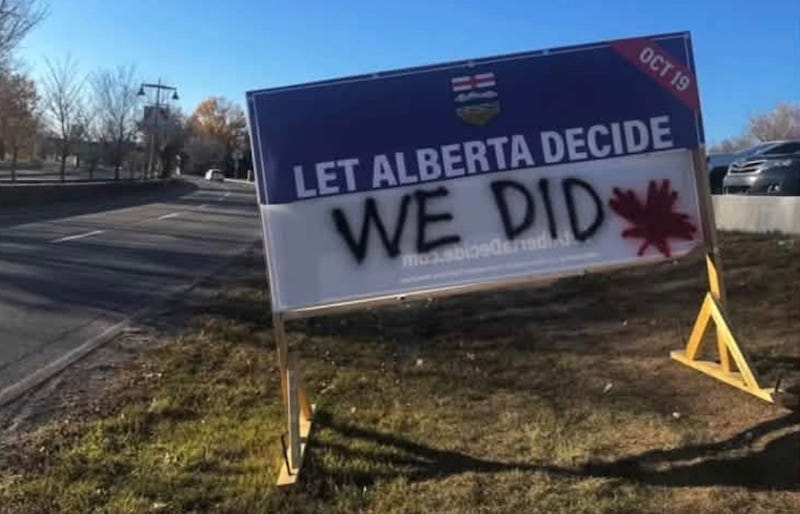
With 5,536 of 5,537 polling stations reporting and 20,514,670 total ballots cast, we now have a much better look at the results of Alberta’s 10 referendum questions than we did when the vote counting started late Monday night.
1. Support for Alberta remaining in Canada is strong across the board
Option 1 to support Alberta remaining a province in Canada has earned 1,545,242 votes so far, totalling 75% of the vote on the most high profile of the 10 referendum questions. Separatists appealing to Albertans in the final weeks of the campaign to send a message to Ottawa by voting for Option 2 to hold a future binding referendum on separation, earned 514,043 votes — 25% of the total province-wide vote.
The vote to remain in Canada was strong across Alberta but strongest in the two largest urban centres and in First Nations communities.
More than 80% of voters in every riding in Edmonton voted for Alberta to stay in Canada, and the remain side earned more than 75% of the vote in every Calgary riding. More than 79% of voters in the cities of Airdrie and Lethbridge and the Banff-Kananaskis riding supported remaining in Canada. Turnout reached historic highs in many First Nations communities with support more than 90% in favour of remaining in Canada.
Many ridings outside the big cities voted to remain by more than 60% and only a majority of voters in two ridings voted for Option 2 to hold another referendum to leave. Separatists earned 50.9% in Rimbey-Rocky Mountain House-Sundre and 50.3% in Central Peace-Notley ridings. Results were also close in the Drumheller-Stettler and Taber-Warner ridings.
It is worth noting that the separation option received less votes than the total number of signatures that would have been required to trigger a citizen initiative referendum when the Citizen Initiative Act was initially passed in 2021 (the signature threshold was later significantly lowered by Premier Danielle Smith’s United Conservative Party government to accommodate the separatist Stay Free Alberta petition).
2. The immigration questions pass with weak mandate
The five immigration and citizenship related questions passed, though not with the strong endorsement that Smith’s UCP were expecting. At this point in the count, it appears that Question 5, which requires voters to show proof of citizenship, is the only one of the five questions that earned more than 55% support from Alberta voters.
The other questions hover much closer to the 50% mark, likely owing to the controversial nature of the topic, the wordy and confusing language used in the text of the questions, and the UCP’s decision to not engage in meaningful efforts to get out their vote on these questions.
The immigrations questions were rejected by a majority of voters in Calgary and Edmonton.
A provincial government asking for permission to assert more control over immigration policy is a legitimate ask, but the way these questions were worded and Smith’s framing of the issue created doubt about her intentions.
Smith appeared to blame immigrants and their families for the challenges facing the health care and education systems and UCP government’s budget deficit in the spring. The budget deficit later turned into a $2 billion surplus when Iran closed the Strait of Hormuz after US President Donald Trump launched a military attack on the Middle East country.
The results of these questions are troubling, and I have read a lot of commentary on social media about how racism and xenophobia were the reasons why they passed. While I don’t disagree that those beliefs are a driving force for some voters, especially people heavily influenced by radical MAGA politics south of the border, a thoughtful friend of mine observed that this might also be a result of the economic anxiety and unease that many Albertans are currently feeling about affordability and cost of living issues.
There is a lot of unpack from the results of the immigration questions and what it says about Alberta that will require some dedicated space to this issue.
3. Albertans reject Smith’s proposed constitutional reforms
The four questions that Smith put to voters to bolster her efforts to increase Alberta’s autonomy through constitutional reforms have all been narrowly rejected by Albertans. These questions were strongly rejected by voters in Calgary and Edmonton, and also given weak endorsements from voters in many rural ridings, where the UCP would have expected support to be strong.
These rejection of these proposed constitutional reforms that aimed to give more power to the provincial government are a blow to the one of Smith’s guiding documents, the Free Alberta Strategy, which was co-authored and championed by her Chief of Staff, Rob Anderson.
These results could also signal that a growing number of Albertans are tired of the UCP’s constant fights with the federal government, now led by Prime Minister Mark Carney (who, some polls show, is now the most popular politician in Alberta).
The failure of the question asking Albertans to support abolishing the unelected Senate is also a blow to Senate reform advocates — and the three Senate nominees that were selected in 2021 through the UCP government’s Senate Election Act.
4. Referendum didn’t address affordability, health care and cost of living
What Smith’s referendum questions didn’t deal with are the biggest issues that are worrying Albertans today. This could explain a lot about why many Albertans were less than enthusiastic about the nine immigration and constitutional reform questions proposed by Smith.
According to recent polling from Abacus Data, 77% of Albertans say the UCP government is doing a poor job on improving the cost of living, 70% say the government is failing on housing affordability, and 64% say it is doing a poor job on health care.
The Abacus poll showed that many of UCP supporters feel the government is falling short on these important issues. Among UCP supporters surveyed, 62% say the government is doing a poor job on improving the cost of living, 53% rate it poor on housing affordability, and 48% rate it poor on health care.
Smith has seen her own approval rating drop over the course of the referendum campaign and her UCP rebuked by voters in the Calgary-Shaw by-election.
With the referendum over, there is a big opening for Smith to shift toward these important issues — or for Naheed Nenshi’s NDP to finally move in and own the affordability and cost of living issue.
5. Danielle Smith takes aim at separatists and Nenshi’s NDP
With the referendum suggesting that Albertans don’t see Ottawa as the boogeyman it used to be, Smith turned her attention to attacking separatists in her own party and Nenshi’s NDP in a video directed to UCP members released online on Wednesday.
Smith called on separatists in the UCP to park their efforts to leave Canada and instead focus their attention on defeating the “woke” NDP in next year’s provincial election. A recent poll from Pollara shows the NDP with 50% support across the province, ahead of the UCP’s 46%.
Smith declared that no openly separatist candidates will be allowed to run for the party’s executive positions or be nominated as UCP candidates in the next provincial election.
Smith is facing calls for her resignation by at least three UCP constituency associations and high profile separatists (who are in their own chaotic state of disarray) as some UCP members continue to push to adopt Alberta separation as an official party policy at the party’s Annual General Meeting in Calgary at the end of November.
Separatists entrenched in the UCP have flexed their organizational muscle at the UCPs past two AGMs, with significant wins in the executive elections and in the policy votes, and it is expected that they will attempt to do the same next month.
UCP constituency associations in Highwood, Calgary-Buffalo and Calgary-Currie have voted to put Smith’s leadership to a vote, and will need 19 more constituency associations to do the same to trigger the same process that cut short Jason Kenney’s political career in 2022.
Smith’s supporters have pushed back against the separatists, with UCP associations in Calgary-Beddington, Calgary-North East, Calgary-North West, Calgary-West, Edmonton-Beverly-Clareview, Edmonton-City Centre, Innisfail-Sylvan Lake, Olds-Didsbury-Three Hills, Sherwood Park and others to endorse her continued leadership.
Smith has tolerated and even encouraged openly separatist supporters in her party until now. She depended on many of them in her bid to win the UCP’s leadership in 2022 and the general election in 2023, so the big question left in the minds of many Albertans who watched Smith’s video this week is: why did she wait until now to purge the separatists from her party?
Smith was hedging her bets on the results of the separation referendum, which is the single most cynical political play I’ve witnessed since I started writing about Alberta politics more than 20 years ago.
6. Watch out for Gerrymandering in the electoral boundaries report
The referendum results show a province deeply divided along urban-rural lines, which is why Albertans should pay close attention to the new electoral boundaries for the next provincial election.
The advisory panel tasked with redrawing riding boundaries ahead of the next provincial election has submitted its recommended map to the MLA committee that was given that responsibility after the UCP government tossed out the maps recommended by the bipartisan Electoral Boundaries Commission earlier this year. The MLA committee will meet for its first public meeting in months on October 28.
There is widespread concern that the new maps, which increase the total number of ridings in Alberta from 87 to 91, will more closely reflect the minority report maps drawn by the UCP appointees to the commision. Those maps were widely panned as gerrymandering, favouring reliably UCP-voting rural voters over NDP-voting city dwellers in controversial hybrid urban-rural ridings that slice parts of Alberta’s cities into large rural ridings.
Alberta’s next provincial election is scheduled to be held on October 18, 2027, but I wouldn’t be surprised if Smith decides to call it earlier.

An Alberta referendum deep dive on Craft Politics
Just in case you missed it, I recently joined Joseph Lavoie on Craft Politics for a deep dive discussion about Alberta’s referendum and how the results could impact Alberta politics and Smith’s future as leader of the United Conservative Party.
Erin Averbukh defeats Jeevan Mangat in Calgary-Acadia UCP nomination contest
Past city council candidate Erin Averbukh defeated former Wildrose Independence Party leader Jeevan Mangat to win the UCP nomination in Calgary-Acadia on October 22. Averbukh defeated Mangat 456-162 in the vote of UCP members in the south Calgary riding.
Right-wing political activist Craig Chandler was initially involved with Averbrukh’s campaign but stepped down to managed UCP candidate Mike Derry’s campaign in the Calgary-Shaw by-election. Her campaign was managed by David Aftergood.
The riding is currently represented by NDP MLA Diana Batten.
Former MP and recent mayoral candidate Rahim Jaffer is facing Parker Royer in a the UCP nomination vote in Edmonton-North West today.
Jaffer served as the MP for Edmonton Strathcona from 1997 to 2008 and ran in Edmonton’s 2025 mayoral election.
The riding is currently represented by NDP MLA David Eggen.

More Alberta politics
The fall session of the Alberta Legislature returns on October 27. UCP Government House leader Joseph Schow previewed the government’s legislative agenda at a press conference yesterday.
National political commentator Chantal Hébert, former premier Rachel Notley, and former Progressive Conservative cabinet minister Gary Mar, will join University of Alberta professor Jared Wesley for a discussion titled After the Referendum: What Comes Next? on October 26.
Abacus Data CEO David Coletto will speak at the University of Alberta about Leadership and Policymaking in Precarious Times on October 29.