
Teachers on strike in Alberta, UCP digging in for a long fight
Breaking the ATA is in the official UCP policy book

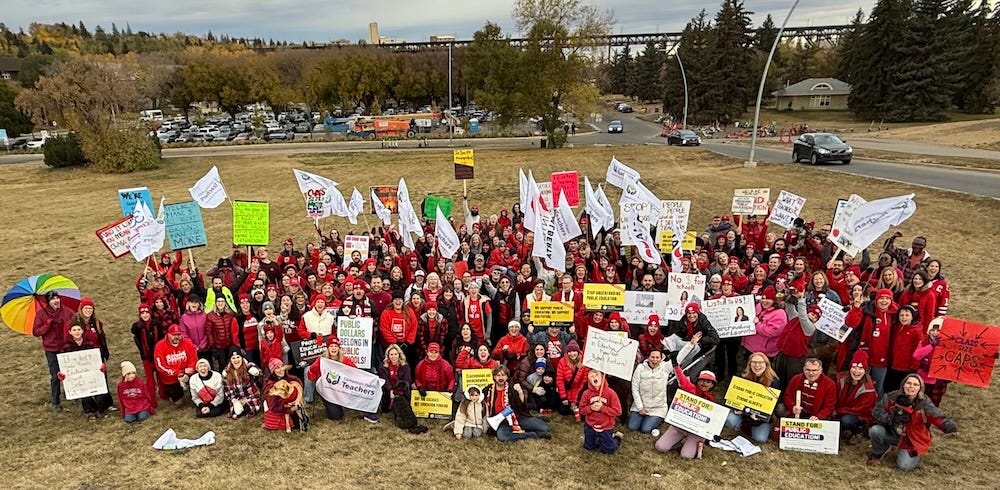
Schools are empty this week as more than 51,000 Alberta teachers in public, Catholic and Francophone schools launched the largest strike the history of their profession in Alberta.
The strike comes shortly after members of the Alberta Teachers’ Association overwhelmingly rejected a new contract for a second time in less than six months, with more than 90% voting against the proposal in the final days of September.
“Our classrooms, hallways and school fields are empty, and not because we’ve given up on public education but because we care too much about it to stand by and watch it slowly erode and crumble from chronic underfunding,” ATA President Jason Schilling told reporters at a press conference on Day 1 of the strike that began on October 6.
Two of the biggest issues teachers immediately bring up when asked about the strike are workload issues: per-capita student funding and classroom sizes.
Alberta is at the bottom when it comes to per-student funding in Canada for public education. This is one of the the biggest issues the ATA has focused on over the past year, including in an ad campaign the union launched more than a year ago.
The ATA claims that the provincial government currently funds schools at $11,464 per-student, which falls way below the national average of $13,692 per-student and below our neighbours to the east in Saskatchewan at $12,546 per-student and to the west in British Columbia at $13,140 per-student.
Alberta’s population is booming and so are the number of students in classrooms but you won’t find any official numbers because the government stopped tracking classroom size in 2019. The number of students per class matters because it clearly impacts a teacher’s workload and the quality of education that students will receive.
Calgary-Beddington NDP MLA Amanda Chapman introduced a private members’ bill in 2023 that would have reintroduced classroom size tracking but it was defeated in a 44-19 vote in the Legislature.
While it’s not the most important issue teachers will talk about, salary is still a big sticking point.
The government describes its proposal to increase teachers salaries by 12 per cent over 4 years as a “fair deal for Alberta teachers” but teachers made it very clear that this is not good enough. They point to the past six years, which saw teacher pay rise by 3.8 per cent while inflation has jumped by nearly 21 per cent in that same period.
UCP digging in for a long strike
Premier Danielle Smith, Minister of Finance Nate Horner, and Minister of Education and Childcare Demetrios Nicolaides say they are disappointed with the strike but have given no indication they were eager to return to the bargaining table to, well, actually bargain.
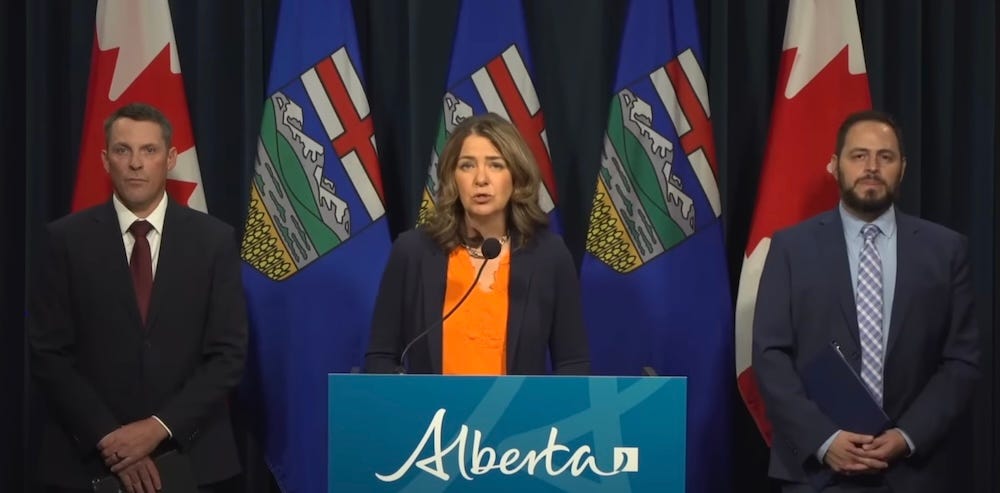
Smith, Horner and Nicolaides have signalled that they are prepared for a long teachers strike, and, despite claiming the cupboards are bare, the government will pay parents $30 a day to do teachers’ jobs from home, sort of, during a strike.
While strikes like this don’t have an official end date, it’s widely expected that it could last at least until the Legislature returns for the fall session on October 23 when the United Conservative Party government could pass legislation forcing an end to the teachers’ job action.
Government ads are slicker than it’s spokespeople
The UCP government launched a series of advertisements shortly after the ATA announced its plans to strike. The ads promote what the government describes as “a good plan” and are short, easy to understand, and are framed as a policy proposal rather than a bargaining position.
Where the paid advertising ends and the spokespeople start talking is when the government’s messaging starts going off the rails.
The government’s messaging was derailed last week when senior UCP staffer Bruce McAllister publicly berated a high school student for asking a question about the teachers’ strike and private school funding during the Alberta Next panel town hall in Calgary. McAllister, a former news anchor-turned-Wildrose Party MLA who now runs the Premier’s Office in Calgary, told the young man that his parents should spank him before he cut off his microphone.
McAllister’s creepy and patronizing outburst is probably a case of the government saying the quiet part out loud. He gave Albertans a glimpse of what the people in Smith’s inner circle might think about teachers and students who ask uncomfortable questions.
UCP cries poverty on funding but promises to build more schools
While the government cries poverty when it comes to the per-student funding, classroom sizes, and salary increases teachers are asking for, Smith frequently points to her big promises of capital investments in the education system.
Smith promised in a televised address last year that the UCP government would build 130 new schools by 2031, which is a lot, but with the student population of the province growing by more than 33,000 per year (Smith’s number), that’s just playing catch up.
The government also pledged to hire 3,000 new teachers as part of the proposed contract that ATA members voted down. Three thousand is a big number but it’s not going to do much to decrease the number of students in each classroom when those the new teachers are spread over 2,000 schools across the province.
It’s a big number but it’s a drop in the bucket.
Posh private schools get public funding in Alberta
Looming large over the government’s labour dispute with teachers in public, Catholic, and Francophone schools is the lavish funding the province spends on private schools.
Private schools in Alberta get 70 per cent per-student funding from the provincial government, which is the highest of any province in Canada. That tops BC, which funds private schools between 35 and 50 per cent, Saskatchewan, which funds up to 50 per cent. Ontario and the Atlantic provinces do not fund private schools at all.
Although there is a wide spectrum of private schools that provide different types of education to different groups of students, some of the private institutions receiving generous public funding include elite schools tailored to Calgary’s wealthiest families and charge more than $20,000 in annual tuition.
Smith has been careful to avoid mentioning these handsome contributions but a new citizen initiative launched by Calgary teacher Alicia Taylor wants to put government funding of private schools to a province-wide vote.
Breaking the ATA is in the official UCP policy book
Breaking up the ATA and making membership in the union optional for teachers are actual official UCP policies that were enthusiastically passed by delegates at the party’s convention last year in Red Deer.
In defending the policy to make membership optional, the UCP constituency association from Innisfail-Sylvan Lake wrote that the ATA is “supporting many controversial progressive ideologies that do not represent the values of many teachers who are forced to pay dues in order to maintain employment in this province.”
The policy was passed weeks after anti-sexual health education protests organized by UCP-connected activists were held outside the ATA’s offices in Edmonton. The political mood of those protests align with Nicolaides moral panic book ban fiasco and the government’s targeting of transgender and female students who want to play school sports.
But partisan conservatives didn’t always feel this way about teachers.
Teachers used to be part of the PC Party big blue tent
Teachers used to be an important part of the big blue voter coalition that made the old Progressive Conservative Party an electoral juggernaut from 1971 to 2015.
There was even a former ATA President, Halvar Johnson, who served as a PC MLA under premiers Peter Lougheed and Don Getty and later as a cabinet minister in Premier Ralph Klein’s government. The relationship between teachers and the PC government had its rocky moments, but it was still common for teachers and even ATA officials to attend and participate in debates and votes at PC Party conventions.
Teachers were even widely believed to have played a big role in the election of Alison Redford as leader of the PC Party in 2011 and the subsequent defeat of Smith’s Wildrose Party in the 2012 election.
I had a bit of a front row seat to this.
I was speaking on a politics panel at the ATA’s summer conference in 2011 when the PC leadership candidates’ buses rolled up to the Banff Centre. An event like this wasn’t unusual. The ATA encouraged its members to get active in all party leadership races but the PC Party had been government for four decades and it was the big show in town.
The prospective candidates for premier participated in a Q & A session in front of hundreds of teachers. Former teacher and long-shot candidate Doug Griffiths got a lot of cheers but it was clear by the end of the forum that Redford was the crowd favourite.
While their actual influence in the leadership vote and the election a year later was probably overstated, a lot of Wildrose supporters openly pinned the blame on teachers and other public sector workers for their defeat.
University of Calgary political science professor Ian Brodie, who served as chief of staff to Prime Minister Stephen Harper, speculates in his The Thursday Question newsletter that politically motivated teachers could cause trouble for Smith by showing up en masse to the UCP AGM in Edmonton at the end of November.
There will probably be some teachers who attend the convention but I suspect those will be teachers who are already active UCP members and supporters. In the polarized political environment that defines partisan politics today, I’m skeptical that we’ll see a wave of teachers fresh from the strike willing to pay the fees to go to the UCP AGM, even if it is in Edmonton.
The UCP is not trying to build the big blue tent the PC Party managed to maintain for 43 years. That mould was shattered when Rachel Notley’s NDP defeated the PC dynasty in 2015.
Despite attempts to paint them as radical, teachers as a profession are a fairly mild-mannered group and the ATA actually has a reputation of traditionally being a fairly cautious and politically moderate organization. That’s one of the big reasons why this strike is such a big deal.
Pipeline in Pre-Planning Phase
Pipeline politics are back thanks to Premier Smith’s announcement that the provincial government will spend $14 million to fund the pre-planning phase of a theoretical oil pipeline from Alberta to northern British Columbia.
