
Undermining public trust in public libraries is the real aim of Dan Williams’ Bill 28
Public libraries in Alberta are worth fighting for

Quick note: This piece was originally drafted to be the script of an In Session episode of the Daveberta Podcast but life has been quite busy and I didn’t have time to sit down in the recording studio last weekend. I wanted to be sure I published this in some form before the end of the Legislative session on Thursday (and I hope to record a new podcast soon).
Public libraries in Alberta are worth fighting for
Undermining public trust in librarians is the real aim of Dan Williams’ Bill 28
In the age of Artificial Intelligence, algorithms, easily spread misinformation, and privately owned social media platforms, who better is there to trust in our society than librarians? Like teachers and other educators, professional librarians and library staff are on the frontlines of the fight to preserve and protect credible public information and knowledge.
Public libraries are probably one of the last truly public spaces we have in our communities. They aren’t a private space that you have to pay to access by buying a ticket, membership, or a coffee. Public libraries are for everyone - and they offer much more than books. They provide programming for kids and adults, courses, resources, and a place for community gatherings.
The are an important space for new Canadians who are learning English or French and are searching for resources and community to help them in their new home.
Because they are for everyone, local public libraries are also one of the few welcoming public spaces open to some of our most vulnerable neighbours, people facing homelessness or mental health issues who just need a warm, dry and safe place to hang out for a while during the day.
That puts librarians on the front lines of our communities. They don’t wear uniforms or drive cars with loud sirens but, in so many ways and more, librarians are some of the helpers that Mr. Rogers eluded to decades ago.
So, it was concerning to see that local public libraries and librarians had a big target on their backs in the United Conservative Party’s spring legislative agenda.
Undermining public trust in librarians is the real aim of Dan Williams’ Bill 28
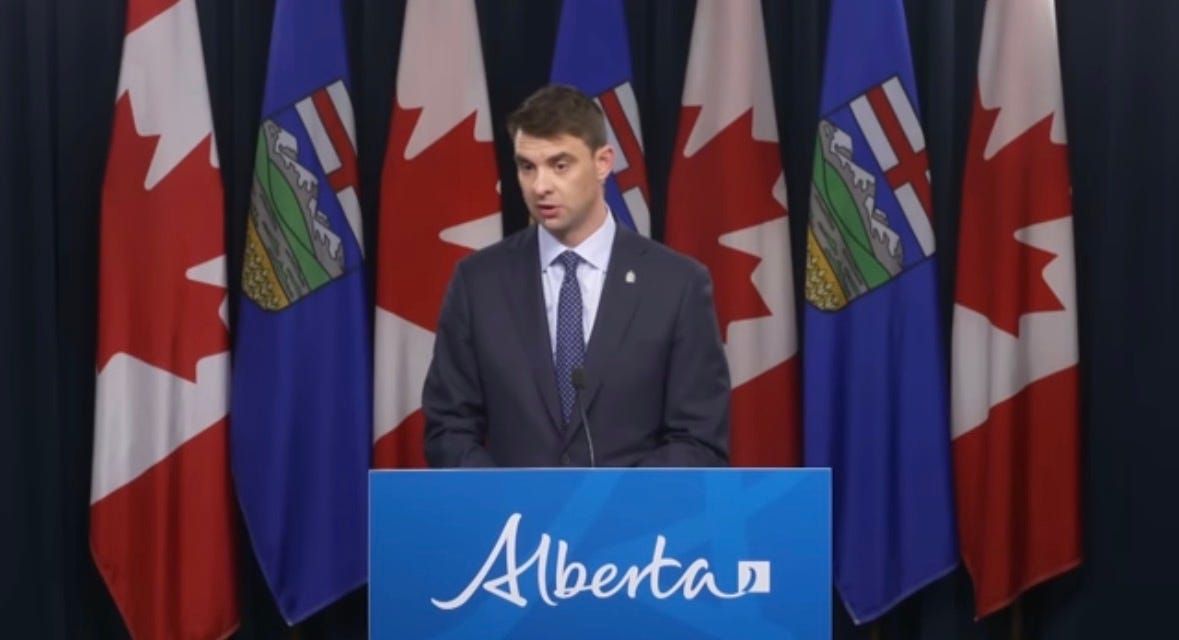
Bill 28 Municipal Affairs and Housing Statutes Amendment Act, introduced by Municipal Affairs Minister Dan Williams, is a broad bill that includes a suite of changes to municipal rules around housing construction approval, school property, municipal council rules, and more, but it’s the changes to the Libraries Act and Libraries Regulation that have garnered the most attention.
Bill 28 passed second reading last night in the Legislature.
The Alberta government press release from April 2, 2026 said that the bill will:
…allow the minister to initiate reviews or respond to complaints related to public libraries. This provides a clear and consistent process to address concerns and support accountability across Alberta’s library system. The proposed changes would also allow the minister to issue guidance and non-binding guidelines to support public library governance.
These provisions establish a foundation to support age-appropriate access to public library materials that include explicit visual content, with additional details to be developed through upcoming regulation. These changes will be implemented through future regulations and protect children by restricting access to sexually explicit visual materials in public libraries to individuals 16 and older. Minors 15 and under will not be permitted to access materials without parental consent.
When debating the bill for the first time on April 23, 2026, UCP Government House Leader Joseph Schow declared the most important part of Bill 28 “is protecting our children from explicit pornographic books in public libraries. I will repeat that. This bill protects our children from explicit pornographic books in public libraries.”

Public libraries are not where young people are stumbling upon or actively looking for pornography or inappropriate sexual material.
We are living in 2026, not 1956.
Many young people have access to all the internet has to offer through their computers at home or mobile phones their parents have bought for them. It is extremely disingenuous for Williams to stoke a fake morality crisis about pornography without talking about the internet. If you’re not talking about fixing that problem, then you’re not serious about stopping young people from accessing inappropriate sexual material.
What Williams’ Bill 28 does do is attempt to undermine the tremendous credibility and trust that Albertans have for public libraries by insinuating that librarians are allowing children to access inappropriate material and that the volunteers who sit on local library boards aren’t doing what’s best for their communities.
Williams and Schow claim that Bill 28 will protect children, but like the book ban in school libraries clumsily implemented by Minister of Education and Childcare Demetrios Nicolaides last fall, it is fixing a problem that doesn’t exist and tries to fabricate a moral crisis out of nothing.
As reported in March 2026, Nicolaides school book ban led to the removal of more than 160 books, including “graphic novel versions of Margaret Atwood’s A Handmaid’s Tale and George Osrwell’s 1984 — both dystopian stories about government control.”
Like so much of Premier Danielle Smith’s political agenda, it borrows from what is happening south of the border. The government run by Florida Governor Ron DeSantis, a politician Smith has said on numerous occasions that she admires, has banned more than 700 books from public school libraries in that state.
Alberta librarians and library boards quick to respond to Bill 28
The speed at which librarians and the community volunteers who sit on local public library boards across Alberta responded to Williams’ bill was swift.
The Town of Mayerthorpe Library Board took on Williams' principal claims straight on in a statement published by the Mayerthorpe Freelancer:
The Mayerthorpe Public Library does not have pornographic material for children, nor does any other public library in Alberta. Our collection is guided by a board-approved collection development policy and is informed by professional library standards. Materials are catalogued and shelved appropriately by age. The library board has a formal process for patrons to request reconsideration of items – a process that has never been used in our community.
The Town of Olds Library board expressed concern that several aspects of a proposed bill could curtail library board autonomy and intimidate staff.
“While we understand the stated intent of protecting children, the practical application of this bill as currently written creates an administrative mandate that threatens the viability of library services across the province,” read a letter from the Olds Municipal Library board that was sent to Olds-Didsbury-Three Hills MLA Tara Sawyer.
Responding to concerns about the library possibly housing materials that parents may object to, the letter says:
“the Olds Municipal Library already has a robust and transparent process for managing controversial materials that respects parental autonomy.”
“Parents may already monitor and choose what their children have access to. Parents may also monitor their children by attending the library with them.
“Bill 28 creates a redundant and expensive bureaucracy that removes parental responsibility and forces library staff to act as parental decision-makers by proxy.”
Olds Municipal Library board chair Curtis Cook said during an interview with the Albertan newspaper that “Really it comes down to they’re trying to take away the responsibilities that have typically always been there for libraries,”.
Michelle Preston, director of the Canmore Public Library, told the Rocky Mountain Outlook that:
“The proposed legislation is very concerning – not only has there been a lack of consultation with the public library sector but, despite how this is being framed, it is an act of censorship.”
Preston said that the bill undermines the role of professional librarians and how libraries already curate collections and facilitate age-appropriate access to materials. It also fails to recognize that parents are already involved in their children’s library use.
Red Deer Public Library’s CEO Shelley Ross said in a statement that:
“Our patrons love the convenience of this primarily self-serve branch and we’ve never had a complaint about children being exposed to age inappropriate materials. Public libraries have always expected adults to be involved in supporting their little kids who are learning to read.”
“The provincial government should continue to trust the long line of volunteer Library Board members, chosen from volunteers in the community, who have been running the Red Deer Public Library since 1914 without the province second guessing which books are on which shelves.”
Ron Sheppard of the Coalition of Alberta Public Libraries told Michael Higgins, host of CTV’s Alberta Primetime, that:
We’re really not aware of when the minister ever realized or felt that somehow provincial intervention needed to occur in public libraries. We already have many processes in place to ensure parents have absolute control over what their children view and access. The way the collections are organized and arranged there shouldn’t be an easy way for children to access material that, in the minister’s opinion, is graphic. We don’t quite know where the problem ever was to begin with, so we don’t know what this legislation aims to solve.
James Turk, director of the Centre for Free Expression at Toronto Metropolitan University, wrote in an op-ed in the Edmonton Journal that:
The bill gives the minister of Municipal Affairs the right to exert virtually total control over every public library, at the expense of the municipal and regional library boards that currently govern public libraries and of the professional library staff that run the libraries according to library board policies.
The bill, if passed, replaces the minister’s current limited right to “inspect the records of a board” with unlimited rights over public libraries and their boards. Minister-appointed inspectors would have wide-ranging authority to examine everything the library has or does, to require library employees to answer any question or provide any information the inspector deems relevant.
The inspector then submits a report to the minister. After receiving an inspector’s report, the minister has the power “to make any order that the minister considers appropriate.”
This allows the minister to override any decision or policy of a municipal or regional library board, thereby transferring final authority over every public library in Alberta to the political wishes of whoever is minister of Municipal Affairs.
The Vermilion Public Library board echoed similar concerns about control of their library by the provincial government in Edmonton:
In summary, Bill 28 raises concerns about how public libraries can continue supporting informed communities through open access to diverse, reliable information. Libraries should be driven by community needs, not political directives from Edmonton. Libraries exist to provide access to knowledge, not restrict it through gatekeeping. Changes to this model may limit the freedom to read and local autonomy, while also increasing financial and administrative pressures on libraries like Vermilion’s.
The Chinook Arch Library Board in Lethbridge also raised concerns about Bill 28 taking away local control of library operations and decision making.
These changes come as some small town rural libraries were expressing concerns about provincial funding tightening earlier this year. No extra funding appears to have been offered by the province to deal with the operational requirements of the proposed rules.

In fact, municipal governments like Calgary and Edmonton provide significantly more funding for public libraries in their cities than the provincial government, yet this bill would give the province considerably more control over neighbourhood libraries.
The UCP under Premier Smith’s leadership have demonstrated a troubling eagerness to break political norms, concentrate power, and weaken independent and local institutions. The amendments to the Libraries Act and Libraries Regulation in Bill 28 appear to be a part of this agenda.
Public libraries are important and so are the librarians who work in them.
Undermining public trust and weakening the role of librarians and the volunteer library boards that run local libraries will hurt Alberta communities. In the midst of all the political news and noise that we are easily distracted by everyday, it has been reassuring to see how many local library boards across Alberta have spoken out in opposition to Bill 28.
It’s clear that a lot of Albertans believe public libraries are worth fighting for.
Only two and a half days left in Spring sitting
There are four government bills on the Order Paper and only two and a half days left scheduled in the spring sitting, so don’t be surprised if Government House Leader Joseph Schow moves to impose closure and tight timelines for debate as these bills enter the final stages of the Legislative process. The remaining bills include:
Bill 25: An Act to Remove Politics and Ideology from Classrooms and Amend the Education Act, 2026
Bill 28: Municipal Affairs and Housing Statutes Amendment Act, 2026
Bill 32: Electoral Boundaries Commission Amendment Act, 2026
Thank you for reading
Thanks for reading and subscribing to Daveberta. There is never a dull moment in Alberta politics and it continues to be a pleasure to share my thoughts about what’s happening in our corner of Canada with so many of you.
A sincere thank you to new paid subscribers, Patricia, Ethan, Ken, Lisa, Jody, Lizette, Laurence, Samuel, Glen, Elizabeth, Michelle, Wolverine and Stephen, who shared a message saying “keep up the good work!” Thanks for the kind words and for your support!
If you found today’s column interesting, please feel free to share it with a friend or neighbour.
Cheers,
Dave

Excellent article, thanks. It's good to see all those statements against this ridiculous legislation
Another effort by Smith to eliminate ‘Wokeness’ ?? Isn’t education ‘wokeness’ ?? 😵💫