
Will Danielle Smith call an early election in Alberta?
10 big things I’m watching in Alberta politics in 2026

Today marks 21 years since I first launched Daveberta. Thank you to everyone who continues to join me on this journey by reading, subscribing, sharing, and sending feedback about my columns and newsletters about Alberta politics.
10 things I’m watching in Alberta politics in 2026
January is usually a quiet month in politics, meaning it’s usually a good time to look ahead at what to expect in the year to come. We’re now only a few weeks into the new year and can see that this year is going anything but usual in politics at home and abroad.
Here are ten things I will be watching that could have a big impact on Alberta politics in 2026:
1. An early provincial election in Alberta
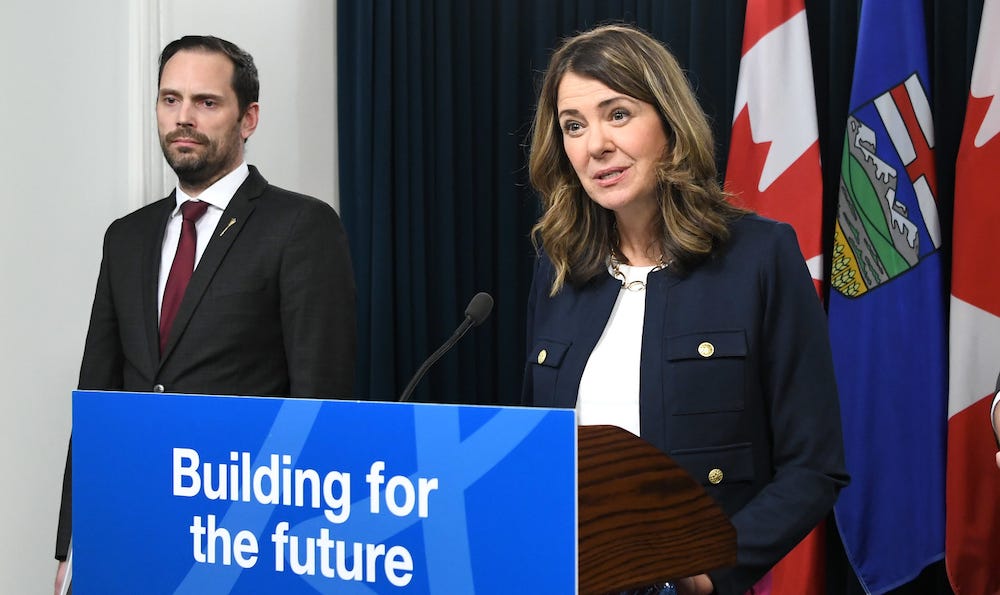
After months of speculation, Premier Danielle Smith said during her 2025 year-end interviews that she isn’t planning to call an early election in 2026, but anyone who pays attention to politics knows: circumstances change.
The next provincial general election is scheduled to happen in October 2027 but there continues to be wide speculation that an early election could be called — and there are plenty of reasons to believe why.
Smith’s UCP remains ahead of Naheed Nenshi’s Alberta NDP in the polls and the governing party continues to raise large amounts of donations. And there is little doubt that Smith remains one of the most effective and shrewd political communicators in Alberta and in Canada’s conservative movement.
Despite public frustration with the sky rocketing cost of living, increasing unhappiness with the direction the province and economy is headed, and a UCP political agenda inspired by American culture war politics, Smith’s government has so far avoided losing any significant support in the polls.
Rebecca Schulz’s recent resignation as Minister of Environment and Protected Areas suggests that the next election is already on the minds of UCP MLAs, some who have already registered their interest to run for re-election with Elections Alberta.
Schulz has been replaced in cabinet by Taber-Warner MLA Grant Hunter but she plans to wait until May 2026 to resign as the MLA for Calgary-Shaw. If a provincial election isn’t called, then a by-election could be held to choose Schulz’ successor.
Some of the other items on this list might help determine whether Smith decides to send Albertans to the polls before the end of 2026.
2. Price of oil much lower than expected
Oil production in our province is at a record high but, as Albertans have learned time and time again, we have absolutely no control over the international price of oil that makes or breaks our local economy.
Forecasts for oil prices are not encouraging for 2026. The U.S. Energy Information Administration has projected that the price of West Texas Intermediate oil could average around $50 to $52 per barrel and, with a glut of oil on the international market, Goldman Sachs expects WTI to average $53 per barrel in 2026.
This is trouble for the Government of Alberta, which relies heavily on revenues from oil and gas royalties to fund the daily operations of public services like heath care and education. The Alberta government’s 2025 budget projected WTI at $68 per barrel but as of the second quarter update in November the average price was $61.50 per barrel. Each $1 change in the price of WTI has an estimated $750-million impact on provincial government revenue.
The imperialist move by American President Donald Trump to use the US military to remove Venezuelan dictator Nicholas Maduro and boast that he now runs the South American country and controls its large oil reserves could create uncertainty and instability for the price of the commodity that Alberta depends on to fund its public services.
3. Donald Trump is increasingly unstable, authoritarian, and expansionist
Increasing political and economic instability in the United States and President Trump’s threats to expand American military and political control over the western hemisphere could have dramatic effects on Canada. The breaking of the United States’ long-standing close relationship with democratic Europe and Trump’s continued threats to annex the Danish autonomous territory of Greenland and make Canada the 51st State could define world politics in 2026.
Just this week Trump posted a doctored photo on social media of him sitting in front of a map with the US flag superimposed over Canada, Greenland and Venezuela. The use of military force to remove Maduro and Trump’s freewheeling use of trade tariffs against countries who’s leaders he feels have personally insulted him suggests that Albertans and Canadians should take him very seriously.
Trump’s rambling, erratic behaviour and his embrace of authoritarianism is deeply troubling and will have a big impact on Albertans and our fellow Canadians across the country.
While Prime Minister Mark Carney appeared to have, at least temporarily, cooled the public heat directed at Canada, his brutally honest speech about the new role of middle powers like Canada is a wake up call about the huge shift that has happened since Americans re-elected Trump to the White House in 2024.
Alberta politics in the first half of 2025 was dominated by Premier Smith’s MAGA charm offensive, including high profile trips to share the stage with far-right media personality Ben Shapiro at a fundraiser for the MAGA-aligned PragerU media organization and a photo-op with Trump at his Mar-a-Lago resort.
Smith backed away from the high-profile charm offensive after Canada’s oil exports were sparred the devastating tariffs Trump aimed at our country’s steel and automotive manufacturing sectors. But UCP cabinet ministers and MLAs continued to make dozens of official trips to American conferences and trade shows — and the UCP continues to borrow from the MAGA playbook to inform their political tactics. UCP Edmonton regional director Abigail Johnson even travelled to Phoenix, Arizona in December 2025 to attend the high-profile MAGA America Fest event.
Former UCP MLA and Assembly Speaker Nathan Cooper was hired as Alberta’s trade representative in Washington DC last year but he’s not the only Albertan trying to influence politics in the American capital city. Leaders of the separatist Alberta Prosperity Project have made several visits to Washington DC in an attempt to influence US policy on Alberta separatism and gain American recognition and commitments to finance a new independent Alberta republic.
We should expect that Alberta separatist groups are also being treated as an eagerly open conduit for those in and close to the Trump administration who want to influence and destabilize Canada in 2026.
4. Referendum on Alberta’s separation from Canada
If Albertans aren’t sent to the polls to vote in a provincial election in 2026 they will almost certainly be asked to vote in a province-wide referendum on Alberta’s separation from Canada.
Former Progressive Conservative MLA Thomas Lukaszuk was the first to spear-head a successful citizen initiative petition when his Forever Canadian campaign collected more than 456,000 signatures by asking Albertans if they wanted their province to remain in Canada.
The wildly successful Forever Canadian petition campaign is being countered by the separatist Alberta Prosperity Project’s flipped citizen initiative question asking Albertans if they want to leave Canada.
The separation petition effort is being led by APP CEO Mitch Sylvestre, who also serves as the President of the UCP’s influential Bonnyville-Cold Lake-St. Paul constituency association. Alberta separatism is almost exclusively a popular idea among UCP supporters, many who were at the party’s recent annual general meeting when Sylvestre accepted the UCP’s Best Fundraiser Award.
Unless Smith decides to throw out the citizen initiative law altogether, Albertans will go to the polls later this year to answer some version of a question about our province remaining or leaving Canada. The referendum could redefine our politics and divide communities and families in Alberta like never before — and will almost certainly be the target of foreign powers with an interest in destabilizing our country.
Smith has already twice moved the goal posts to tip the scales in favour of the separatist efforts - first by lowering the number of signatures required to be collected and second by blocking the ability of the courts to challenge the constitutionality of a citizen initiative ballot question. Smith also ended the fall session of the Legislature by raising the deposit to begin a citizen initiative petition from $500 to $25,000.
A citizen initiative petition calling for an end of government funding for private schools was also launched by a Calgary teacher and is currently collecting signatures, and a petition to block efforts by a large Australian-owned corporation to begin coal mining in the eastern slopes of the Canadian Rocky Mountains is being spearheaded by rancher and country musician Corb Lund.
5. A lot of MLA recall petitions
When UCP MLAs passed the Recall Act in 2021 they almost certainly didn’t expect that they would become the first targets of this direct democracy tool. Four years later there are recall campaigns targeting MLAs in 26 ridings across the province (24 recall campaigns are targeting UCP MLAs and 2 are targeting NDP MLAs).
The first recall campaign, targeting UCP MLA Demetrios Nicolaides in Calgary-Bow, collected more than 6,500 signatures but still finished far from the more than 16,000 signatures required to trigger a recall vote. The high threshold of in-person signatures needed to be collected to trigger a recall vote means that most or all of the campaigns will likely fall short.
The bar is high but overturning the results of a free and fair democratic election should be really hard.
Despite the failed efforts, the Recall Act gave a motivated group of frustrated Albertans an avenue to channel their unhappiness with the UCP’s controversial political agenda and lingering corruption scandals.
6. Alberta Next referendums
The Alberta Next Panel is Premier Smith’s attempt at creating a relief valve to lower the pressure being exerted on her by growing separatist sentiments inside the UCP and guide them away from one single referendum on separation.
In the end, the travelling roadshow resulted in a thin and unambitious 17-page report that recommends holding referendums on pulling Alberta workers out of the Canada Pension Plan and replacing it with an Alberta Pension Plan, and allowing the provincial government more control over immigration.
The creation of a provincial pension plan is a deeply unpopular idea in Alberta, and one that the province’s own pension consultation chair, former PC finance minister Jim Dinning, compared to “a renovation from hell” during his final press conference in the role in December 2023.
