
Danielle Smith dug the separatist hole she's now stuck in
Former conservative premiers Ralph Klein and Peter Lougheed told Alberta separatists to pound dirt

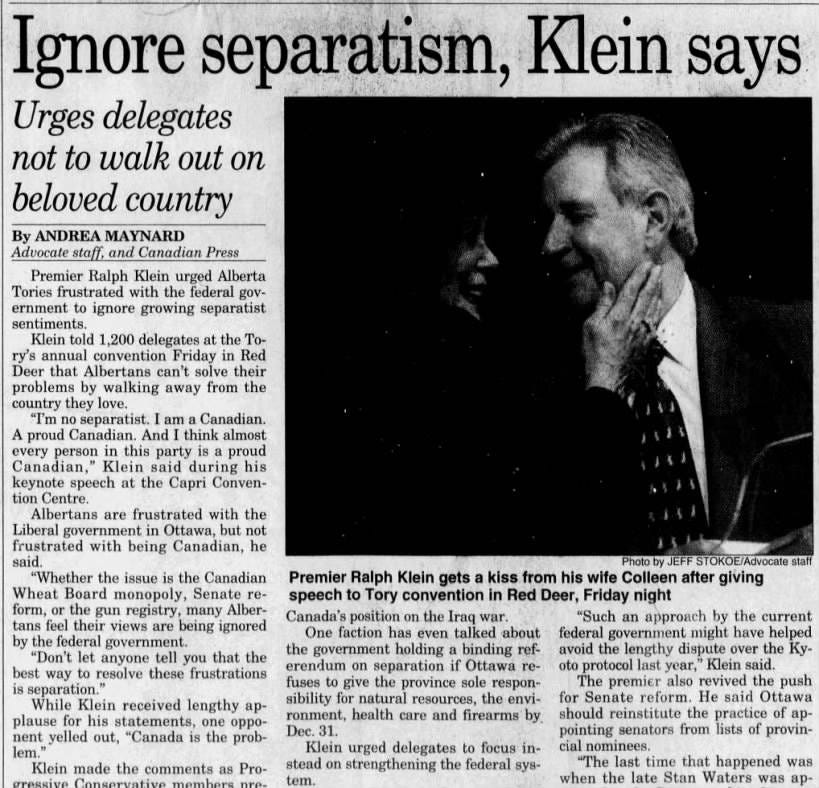
“I’m no separatist. I am a Canadian. A proud Canadian. And I think almost every person in this party is a proud Canadian.”
That was Alberta Premier Ralph Klein’s message to Progressive Conservative Party convention delegates at the party’s convention in Red Deer on March 28, 2003.
Klein was responding to frustration felt by many Alberta conservatives about the federal Liberal government of the time, then lead by Prime Minister Jean Chretien, and calls by some for Alberta to separate from Canada.
“Whether the issue is the Canadian Wheat Board monopoly, Senate reform, or the gun registry, many Albertans feel their views are being ignored by the federal government,” Klein said in his speech. “Don’t let anyone tell you that the best way to resolve these frustrations is separation.”
Klein was right that calling for Alberta to leave Canada wasn’t the way to resolve these frustrations. Only three short years later, Calgary Member of Parliament Stephen Harper was Prime Minister and would lead a Conservative government in Ottawa for the following nine years.
And, as political writer Jen Gerson pointed out on Real Talk yesterday, it wasn’t long after Harper’s win in 2006 that the Wheat Board monopoly was dissolved and the gun registry was scrapped. Whether or not you agree with those big policy changes (or Klein’s political agenda at all) the impact of Alberta conservatives on Canada is undeniable.
“We have evidence that when smart Albertans put their minds together and actually become effective communicators and policy makers we can change the country,” said Gerson.
Gerson has written extensively about Alberta separatism and has joined the Lead not Leave campaign, which bills itself as a Pro-Alberta, Pro-Canada policy initiative. The group is calling on Premier Danielle Smith to not hold a referendum on Alberta separation from Canada.

The Lead not Leave campaign’s opening letter, signed by Gerson, former conservative finance ministers Travis Toews and Jim Dinning, prominent academics Andrew Leach, Trevor Tombe and Jared Wesley, conservative strategist Ken Boessenkool, and former University of Alberta chancellor Peggy Garrity, declares that:
Our goal is to address Alberta’s legitimate frustrations in a way that is productive and pro-active, strengthening both Canada and our province’s place within it. Where separatists are offering attractive ideas, we’ll test them out. When their claims are rooted in wishful thinking or a retreat from grounded reality, we will call them out.
And we start by calling on the Alberta government to not hold a referendum on separation and instead focus on making the case for Alberta in Canada with a credible set of policy proposals - beginning with the progress demonstrated by the recent MOU - that will ensure this next generation of Albertans is leading the country, not leaving it.
Stating clearly that “the status quo is not desirable,” the group aims to “host structured conversations, or salons; test new ideas with stakeholders in policy labs; and contribute actionable ways of improving Alberta’s place in Confederation.”
Not just accepting the status quo is key, especially in a time when many voters increasingly believe the status quo is making life more difficult.
I offered a similar piece of advice to Alberta NDP leader Naheed Nenshi almost a year ago as it became clear the opposition party was struggling in the polls:
In the debate about Alberta separatism, Nenshi has positioned the NDP as the “Stand up for Canada” party. Now he needs to appeal to that significant group of Albertans who want our province to remain in Canada but also think we could get a better deal out of Confederation. Canada isn’t perfect and neither is the relationship between the provinces and the federal government. In this debate, the status quo isn’t going to be good enough. Nenshi should come up with some concrete and aspirational ideas aimed at improving Alberta’s position within Canada.
I still think this is the case, but I’ll update that advice to say that those ideas should be aimed at not just improving Alberta within Canada but improving Canada as a country.
I’m hoping that Lead not Leave might convince the normally risk adverse NDP and their For Alberta For Canada campaign to propose some new progressive ideas for a better Alberta and better Canada.
There’s a real opportunity for pro-Canada voices and thinkers to counter to the fantastical and easily debunked utopian claims and conspiracy theories that loads of AI-generated images shared by separatist social media accounts proclaim await us in an independent Alberta Republic. But it can’t just be countered with fact sheets and fancy reports. Facts are important and they need to be the basis for more powerful emotional arguments for Alberta and Canada.
There’s also an opportunity to counter the zero-sum threats and moving policy goalposts that Premier Smith continues to use to threaten the future of Canada.
Ottawa-based political writer David Moscrop described Smith’s threats to national unity and Prime Minister Mark Carney’s response as “Canada’s Shotgun Federalism.”
“With the Carney ministry offering Alberta concessions on the industrial carbon price and a pipeline in the hopes of, let’s say, ah, nation-building and keeping the family together, the feds got in return exactly what you’d think: nothing,” wrote Moscrop.
“The overestimated-but-still-dangerous forces of Alberta separatism weren’t placated by the bargain, and Premier Danielle Smith continues to try to walk a line so fine that it makes the threads of a spider web look like the trunk of a redwood,” Moscrop wrote. “Her strategy of a “sovereign Alberta in a united Canada,” whatever that means, smacks of wanting-to-have-it-all-itis. I get wanting it all. I’ve been there. But it doesn’t work.”

It won’t work, because while there are plenty of Albertans who have long been unhappy with the Liberal government in Ottawa, a pipeline isn’t going to placate separatist ringleaders who are more interested in creating a Trump-tributary state than furthering any coherent economic policy.
It’s those separatist leaders, many who hold prominent positions within United Conservative Party, who Smith is trying to appease by holding this referendum on Alberta separatism even though Carney has agreed to most of her demands and is spending a lot of political capital to get a pipeline to the Pacific Coast.
Until now Smith has succeeded in appealing to both Albertans who want the province to leave Canada (who most polls show are a majority of UCP voters) and those who want to remain in Canada but are unhappy with Alberta’s relationship with Ottawa. But actually calling the separation referendum appears to have upset her tenuous balancing act.
Separatist leaders are split on Smith’s future, but prominent leavers like Stay Free Alberta/Alberta Prosperity Project CEO Mitch Sylvestre, who is also president of the UCP association in Bonnyville-Cold Lake-St. Paul riding, has openly threatened Premier’s leadership of the UCP.

They are angry that Smith, who decided to call the separation referendum, said she would campaign for Alberta to remain in Canada.
An Angus Reid survey released this week found that 56 per cent of Albertans believe Smith is handling the separatism issue poorly and 58 per cent believe she is calling the referendum to appease the separatists in her party. Sixty-nine per cent of Albertans surveyed believe the separatists will never accept a no vote result in the referendum.
Smith dug the political hole she now finds herself in. After years of bending over backward for the separatists in her party by amending laws, fuelling the flames of resentment, and appealing for them to the courts, she has found herself in a politically untenable situation. Simply claiming to be pro-Canada at the eleventh hour is hilariously unconvincing.
Former conservative party premiers like Ralph Klein, and Peter Lougheed before him, told the Alberta separatists to pound dirt. Because of that the separatists then found themselves marginalized in right-wing parties on the electoral and political fringe.
Klein and Lougheed wouldn’t have allowed the separatists to entrench themselves into the Progressive Conservative Party like Smith has allowed them to dig into the UCP.
Danielle Smith might be damned if she does and she’s damned if she doesn’t, but regardless of how Albertans end up voting in the referendum, it won’t be soon forgotten that she risked the future of Alberta and Canada to save her own party leadership.

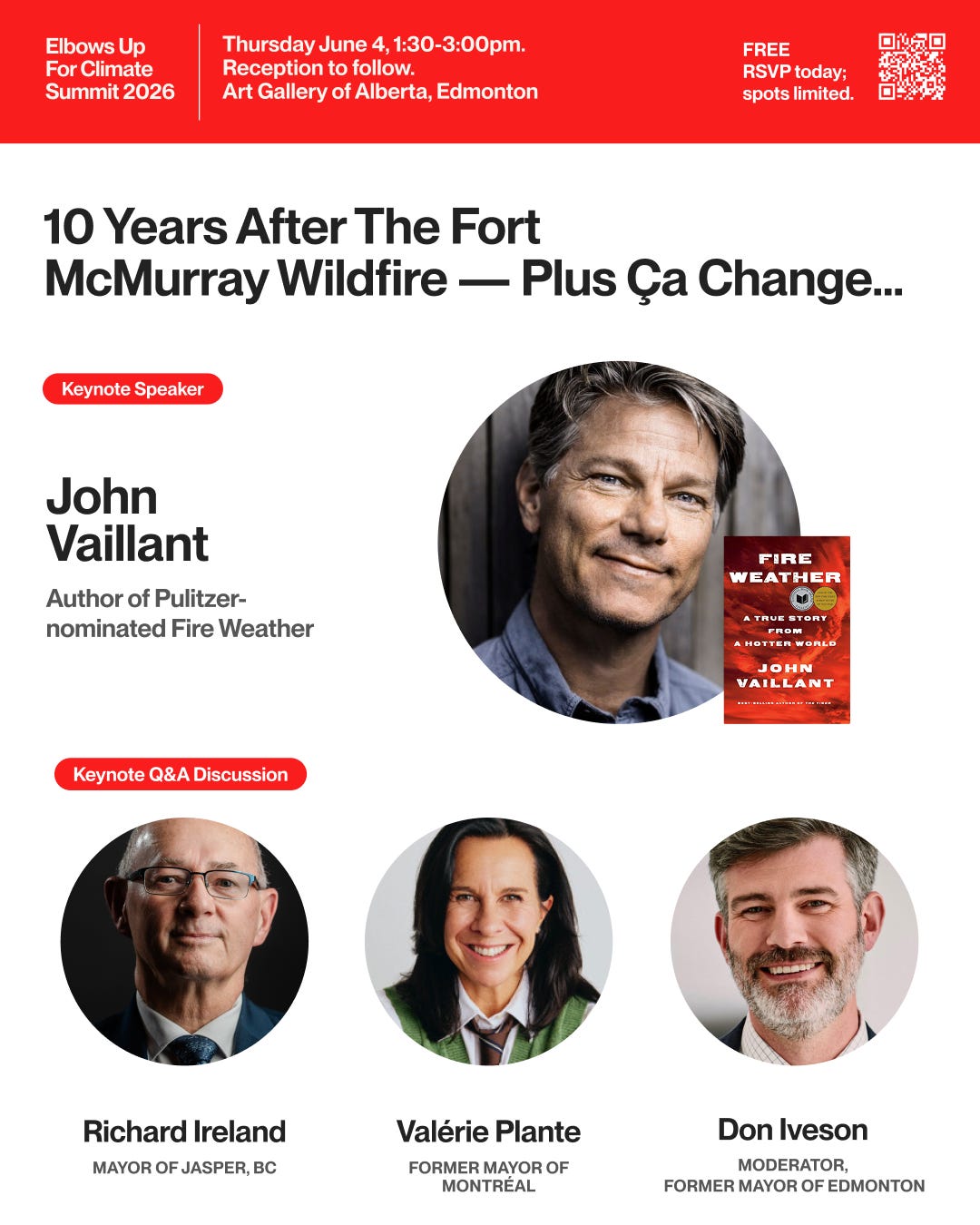
10 years after the Fort McMurray Wildfire — Plus ça change
Pulitzer Prize-nominated author John Vaillant is the keynote speaker at the Elbows Up For Climate Summit 2026 in Edmonton next week. Vaillant’s book Fire Weather won the 2024 Shaughnessy Cohen Prize for Political Writing.
Vaillant is speaking at a free event at the Art Gallery of Alberta on Thursday, June 4 from 1:30 pm to 3:00 pm that will be followed by a Q&A discussion featuring Town of Jasper Mayor Richard Ireland, former Montreal mayor Valérie Plante and former Edmonton mayor Don Iveson.
Thank you for reading and subscribing
Thank you for reading and subscribing to Daveberta. There is rarely a boring moment in Alberta politics and it’s a real pleasure to be able to share my thoughts about what’s happening in my corner of Canada with more than 9,000 Daveberta subscribers.
I will be joining a live stream discussion with independent journalist Jeremy Appel on May 29 at 3:00 p.m. MDT to talk about Smith’s separation referendum, the politics that got us here and what we will face over the next four months.
If you like what you read here on Daveberta, please consider hitting the “like” button on Substack so that more people will see this newsletter and feel free to share it with a friend or on your social media.
Thanks again,
Dave

I don't buy Smith's sudden, road-to-Damascus-like conversion. I think she - and the separatists in her office and caucus - have simply done the electoral math and realized they face electoral doom otherwise, but figure that her debt to the separatists that put her in the premier's office is now paid. Time will tell, but it's just more of the same rank opportunism.
I do have somewhat of a problem putting Peter Lougheed and Ralph Klein in the same sentence. Yes they both advocated against separatism. But as to everything else they were polar opposites - in that Klein operated to destroy every good thing Peter Lougheed had initiated and enacted. To put them together, even on that one issue, leaves the implication that they were “equals” in governing. They were not. They were polar opposites. Just wanted to make that point.